
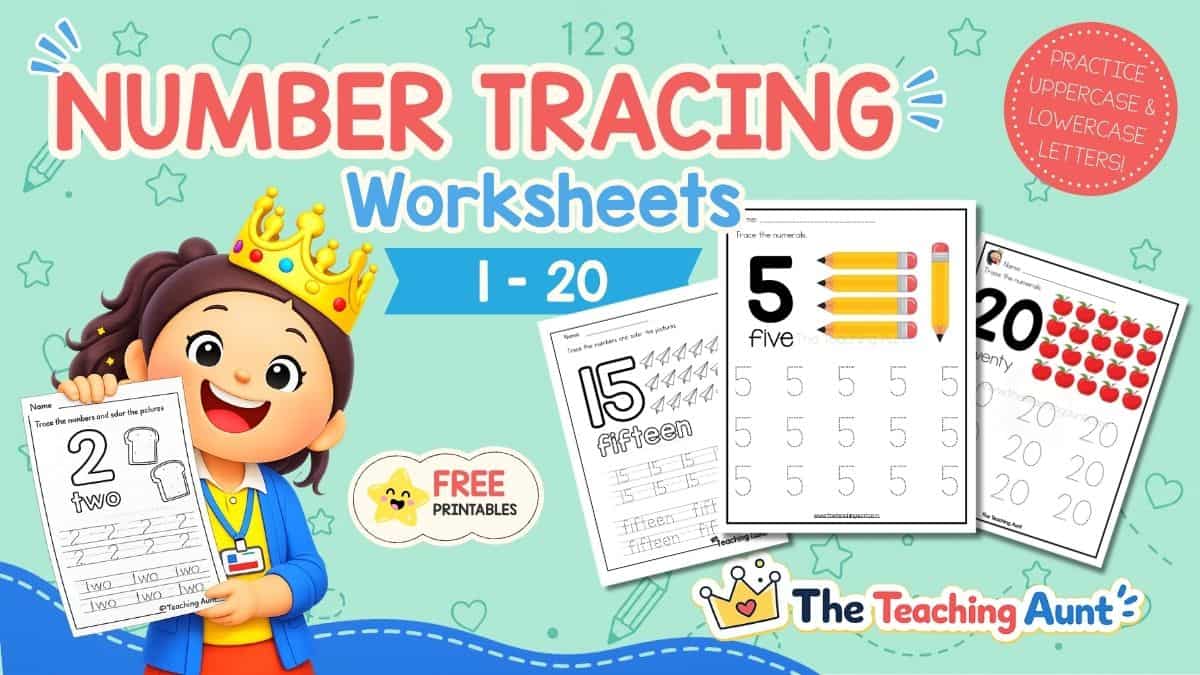
Download these free number tracing worksheets to help your child master writing numbers 1-100 in no time! Practice writing numbers 1-10, 1-20, 1-50, and even 1-100.
Learning to write numbers takes time, practice, and lots of repetition. And if you teach preschool, you already know that asking a child to “write the number 5” can sometimes result in a 5, a backward 5, or a completely new number that has never existed before. 😄
That’s all part of learning!
These free number tracing worksheets give preschool and kindergarten children a simple way to practice number recognition and number formation at their own pace.
On this page, you’ll find printable number tracing worksheets 1–10 and 1–20, along with trace and color activities and additional number tracing practice up to 50 and 100.
Whether you’re a preschool teacher, homeschooler, or parent looking for extra number writing practice, you can choose the worksheets that best match your child’s current skill level.

Free Printable Number Tracing Worksheets
Before children can confidently write numbers independently, they need plenty of opportunities to see, recognize, and practice forming them.
Tracing can help children become familiar with the lines and curves used to form each numeral while giving their little hands valuable pencil-control practice.
These printable number worksheets can help children practice:
- number recognition
- numeral formation
- pencil control
- fine motor skills
- counting
- number sequencing
- one-to-one correspondence
And they work best with these Numbers Flashcards that have colorful images, printed numerals and number words in them. Talk about a complete learning experience!
Number writing is only one part of early math learning. Children also need to understand that each numeral represents an actual quantity. For example, recognizing and tracing the number 5 becomes more meaningful when a child can also count five objects.
If your child is still developing this connection, pair these tracing activities with my Counting Objects Worksheets. They give children extra practice counting groups of objects and connecting quantities with numbers.
You don’t have to complete every worksheet or move through the numbers quickly. Start with a few numbers at a time and give children plenty of opportunities to practice through hands-on counting activities, too.
Number Tracing Worksheets 1–20
If your child is beginning to learn how to write numbers, these number tracing worksheets 1–20 are a good place to start.
Each worksheet focuses on number formation and gives children guided tracing practice before they move on to independent number writing.
I recommend starting with numbers 1–5, especially with younger preschoolers. Once those numbers become familiar, gradually introduce the remaining numbers.
Remember, children don’t need to master writing 1–20 all at once. A little practice at a time is usually much more effective than trying to finish several worksheets in one sitting.
If you want a copy of these free preschool tracing worksheets, just click on the links below and then print.


Numbers 11–20 Tracing Worksheets
Once children are comfortable working with numbers 1–10, you can gradually introduce numbers 11–20. Numbers flashcards are a great help to introduce higher numbers, and you guessed it correctly, I also have that covered.
→ Get your Free Numbers Flashcards here.
These worksheets provide additional tracing practice while helping children become more familiar with two-digit numbers.


Trace Numbers 1–10 Worksheets
For children who are just beginning number-writing practice, trace numbers 1–10 worksheets provide a manageable starting point.
Instead of immediately expecting children to write numerals independently, tracing gives them a visual path to follow.
As children trace, encourage them to say each number aloud. You can also have them trace the number with their finger first before using a pencil or crayon.
I like to keep the routine simple:
See the number → Say the number → Trace the number
Once children are comfortable tracing, add a counting activity so they can connect the numeral they are writing with its quantity. If they trace the number 7, for example, ask them to count seven blocks, seven crayons, or seven small toys.


Trace and Color Numbers 1–10 Worksheets
Tracing doesn’t have to be the only activity on the page!
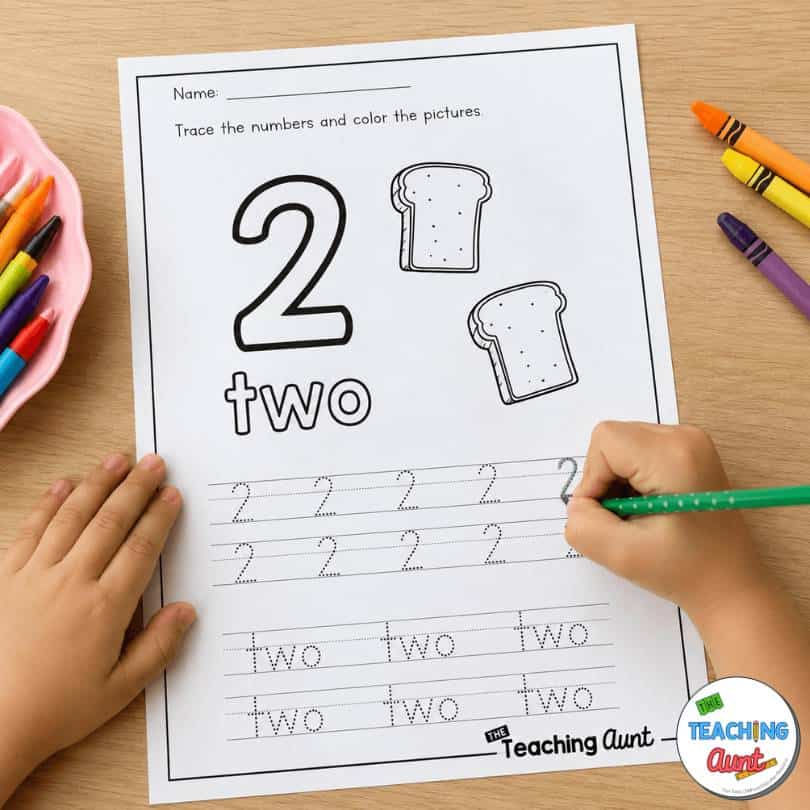
These trace and color numbers 1–10 worksheets combine number-writing practice with counting and coloring.
Children can trace the numeral, count the pictures, and then color them. This allows one worksheet to reinforce several important early math skills.
As children work, ask simple questions such as:
“How many do you see?”
“Can you point to each picture as you count?”
“What number did you trace?”
“Does the number match how many pictures you counted?”
Questions like these encourage children to connect the written numeral with an actual quantity instead of simply memorizing what the number looks like.
From Tracing Numbers to Counting Objects
Once children recognize a numeral, the next important step is understanding what that number represents.
For example, a child may be able to recognize and trace the number 8 but still need practice understanding that 8 means a group of eight objects.
That’s where counting activities become especially helpful.
For more practice with this skill, try my Counting Objects Worksheets. Children can practice pointing to objects one at a time as they count, which helps develop one-to-one correspondence and a stronger understanding of quantity.
You can also use simple objects you already have at home or in the classroom. Buttons, blocks, crayons, toy cars, pom-poms, and counters all work well.
The coloring portion of these worksheets adds extra fine motor practice, too—and, in my experience, a little coloring can make worksheet time much more exciting for preschoolers!


Writing Numbers 1–20 Worksheets
Once children have had plenty of guided tracing practice, you can begin encouraging more independent number writing.
These writing numbers 1–20 worksheets can help bridge the gap between tracing a numeral and writing it without a dotted guide.
There’s no need to remove tracing support too quickly. Some children may be ready to copy numbers independently while others still benefit from tracing.
Both are normal parts of the learning process.


Number Tracing Worksheets 1–50
Children who are already comfortable recognizing and tracing numbers 1–20 may be ready to explore larger number sequences.
These number tracing worksheets 1–50 provide additional practice with numeral formation, number recognition, and sequencing.
There’s no need to rush to 50, especially with younger preschoolers. I recommend using these worksheets when children already show confidence working with smaller numbers.
You can also divide the activity into smaller sections. Instead of tracing 1–50 in one sitting, try practicing 10 numbers at a time.
1-50 Number Tracing Practice Worksheets

Number Tracing Worksheets 1–100
For children who are ready for an extra challenge, these number tracing worksheets 1–100 provide practice with larger number sequences.
They may be particularly useful for kindergarten children who are developing confidence recognizing and writing numbers beyond 20.
There’s no need to complete all 100 numbers in one sitting. Break the worksheet into smaller groups and work through them gradually.
For example:
1–20
21–40
41–60
61–80
81–100
You can also place a hundred chart nearby so children can refer to it as they work.
1-100 Number Tracing Practice Worksheets

How to Use Number Tracing Worksheets
Number tracing worksheets are most effective when they’re combined with hands-on learning rather than used as the only way children practice numbers.
Here are some simple ways to get more learning from each worksheet.
Start with finger tracing.
Before picking up a pencil, ask children to trace the number with their index finger. This helps them become familiar with the movement needed to form the numeral.
Say the number aloud.
Encourage children to name each number as they trace it. This reinforces number recognition while they practice writing.
Count real objects.
Connect the numeral to a quantity whenever possible. If your child is tracing the number 5, place five blocks, buttons, pom-poms, or other small objects beside the worksheet. Have your child touch each object while counting aloud.
For additional practice, you can use my Counting Objects Worksheets after tracing. This creates a simple learning sequence:
Trace the number → Say the number → Count the objects → Match the quantity
Demonstrate number formation.
Show children where to begin and how the pencil moves. Young learners benefit from seeing number formation modeled rather than simply being told to copy it.
Use different writing tools.
Pencils are great, but crayons and washable markers can make tracing more interesting.
Keep practice short.
For preschoolers, a few minutes of focused practice can be more productive than completing several pages at once.
Make Your Number Worksheets Reusable
Want to use your number tracing worksheets more than once?
Laminate the pages or place them inside reusable plastic sleeves.
Children can trace the numbers with dry-erase markers, wipe the pages clean, and practice again another day.
I especially like this option for classrooms and learning centers because you can print the worksheets once and use them with multiple children.
You can also place several worksheets inside a binder to create a reusable number tracing book.
Fun Number Tracing Activities for Preschool
Worksheets are useful, but number formation can also be practiced away from the pencil-and-paper table.
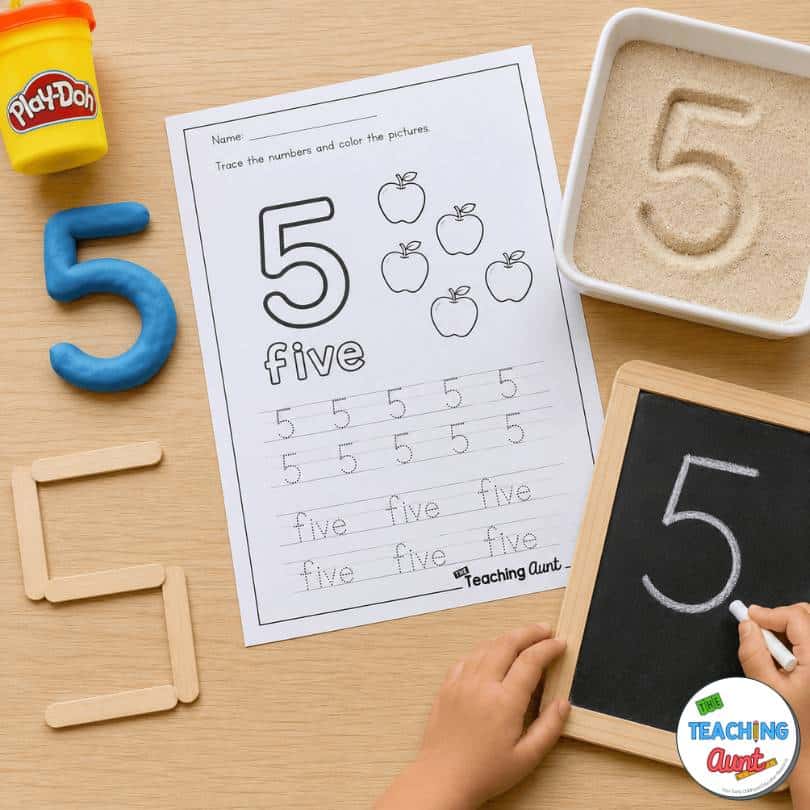
Try pairing these printables with hands-on activities such as forming numbers with playdough, tracing numbers in sand or salt, building numbers with craft sticks, or writing numbers on a chalkboard.
You can also turn number practice into a counting activity.
After tracing the number 6, for example, ask your child to clap six times, jump six times, build a tower with six blocks, or find six crayons.
This helps reinforce an important early math concept:
The numeral tells us how many.
Children aren’t simply learning that a 6 has a particular shape. They’re learning that the written symbol 6 represents a quantity of six.
If your child enjoys this kind of activity, continue the practice with my Counting Objects Worksheets, where children can work on counting pictured objects and identifying quantities.
What Age Should Children Start Tracing Numbers?
There isn’t one exact age when every child should begin tracing numbers.
Many preschoolers become interested in numbers and writing between ages 3 and 5, but readiness varies from child to child.
Before focusing heavily on number writing, children benefit from developing basic fine motor and pre-writing skills through activities such as drawing, coloring, playing with playdough, stringing beads, and tracing simple lines and shapes.
If tracing numbers becomes frustrating, return to simpler pre-writing and hands-on number activities and try again later.
Should Preschoolers Learn Numbers 1–10 or 1–20 First?
I recommend beginning with numbers 1–10.
These numbers give young children a manageable foundation for number recognition, counting, and numeral formation.
Once your child can confidently recognize and work with numbers 1–10, you can gradually introduce numbers 11–20.
Remember that being able to recite numbers in order is different from understanding quantity. A child might happily count “1, 2, 3, 4, 5…” but still be learning how to count five individual objects accurately.
That’s why I like to combine number recognition, tracing, and counting activities rather than teaching each skill completely on its own.
There’s no prize for reaching 100 first! Building a strong understanding of smaller numbers is much more important than moving through the number sequence quickly.
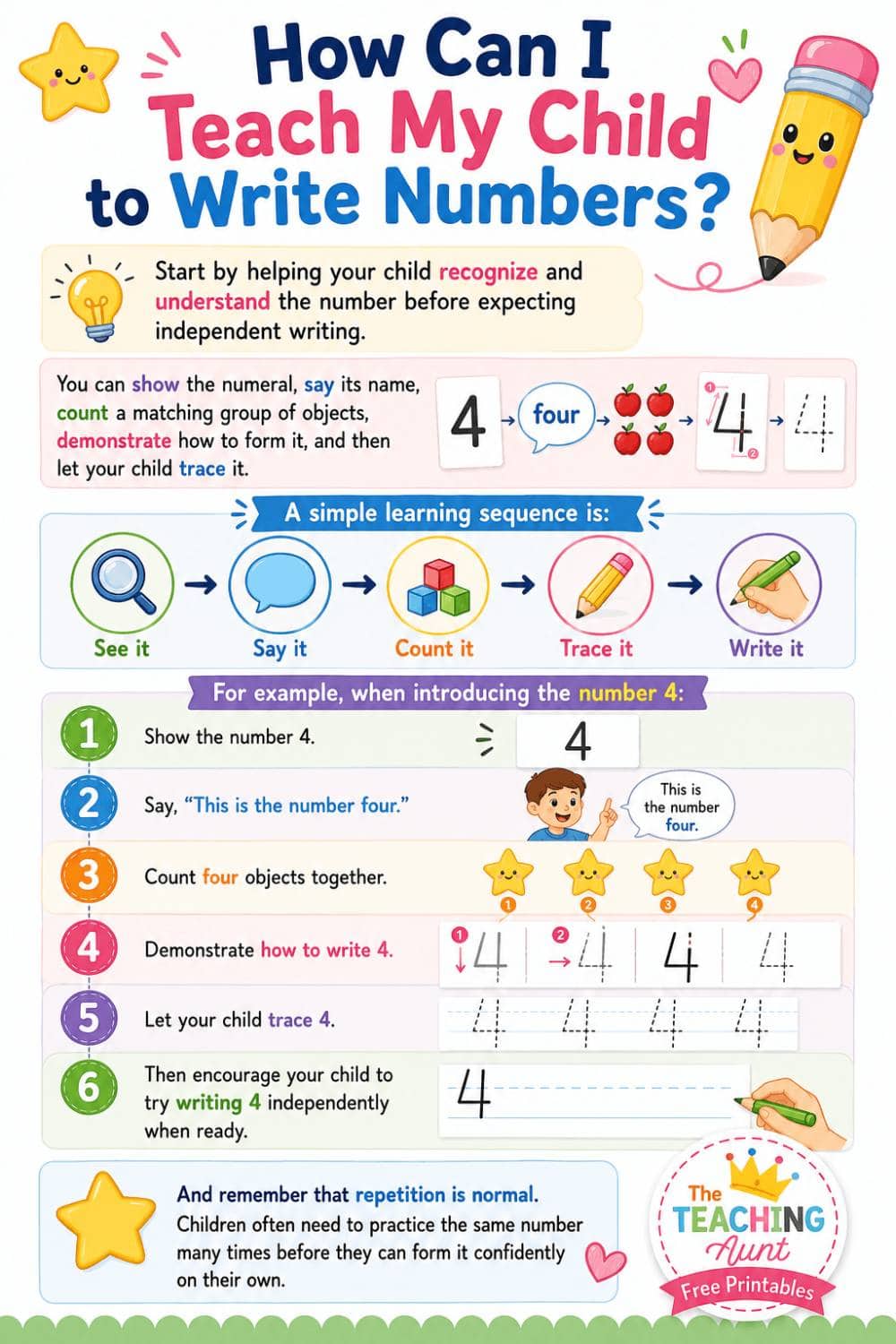
How Can I Teach My Child to Write Numbers?
Start by helping your child recognize and understand the number before expecting independent writing.
You can show the numeral, say its name, count a matching group of objects, demonstrate how to form it, and then let your child trace it.
A simple learning sequence is:
See it → Say it → Count it → Trace it → Write it
For example, when introducing the number 4:
Show the number 4.
Say, “This is the number four.”
Count four objects together.
Demonstrate how to write 4.
Let your child trace 4.
Then encourage your child to try writing 4 independently when ready.
And remember that repetition is normal. Children often need to practice the same number many times before they can form it confidently on their own.
Are These Number Tracing Worksheets Free?
Yes! These number tracing worksheets are available as free printables for parents, teachers, homeschoolers, and caregivers to use with their children or students.
Choose the number range that matches your learner’s current skill level rather than feeling like you need to complete every set.
Start with numbers 1–10, move on to numbers 1–20, and use the 1–50 and 1–100 number tracing worksheets as extended practice when your child is ready.
Most importantly, combine number writing with counting whenever you can. Children are not only learning how to form numerals—they’re developing an understanding of what those numerals represent.
More Free Preschool Math Worksheets
Continue building early math skills with more free printable activities from The Teaching Aunt.
Or just visit my Free Printable Page for more!

P.S.
Do you want PREMIUM FREEBIES? Please subscribe to my blog. I promise it will be worth it!
Oh! And please like and follow us on Facebook and Pinterest! <3
Happy learning,

Last Updated: July 25th, 2026



4 Responses
I love this Teacher Nessy.
Will you be expanding these number worksheets from 1-100 in the near future?
Thanks for the hard work
Happy to serve! Hmmm… Great suggestion. I just might do that. 😊 Happy learning!
These are wonderful thank you.
Happy to serve! Thank you for leaving us a message. 🙂