
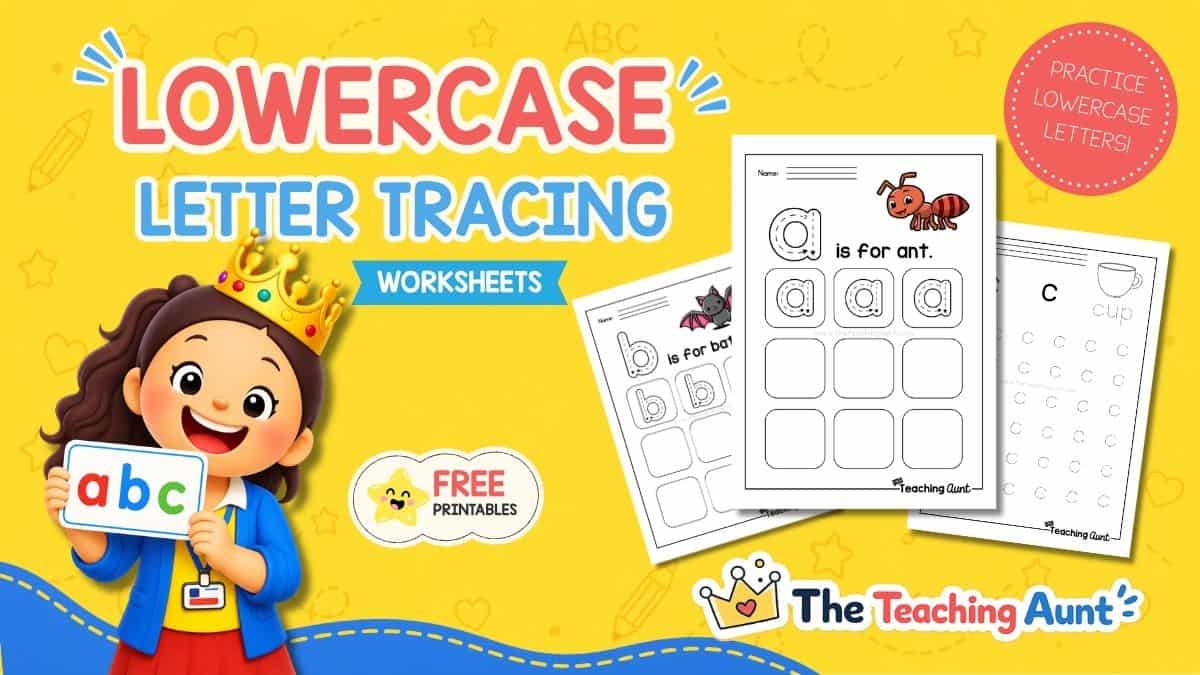
If your child or students are ready to practice their small letters, these free lowercase letter tracing worksheets provide guided handwriting practice for every letter from a to z.
Lowercase letters can be a little trickier than capital letters. Some are tall, some are short, and some go below the writing line. And then we have letters like b, d, p, and q that can keep young writers guessing!
That’s why plenty of hands-on practice and tracing can be helpful.
These printable worksheets are designed for preschool and kindergarten children who are learning to recognize, trace, and eventually write lowercase letters independently.

Free Lowercase Letter Tracing Worksheets a–z
This printable set includes lowercase letter tracing worksheets for all 26 letters of the English alphabet.
Children can practice tracing:
a b c d e f g h i j k l m
n o p q r s t u v w x y z
The worksheets provide guided practice so children can become familiar with the different strokes and movements used to form small letters.
Use them for:
- Preschool handwriting practice
- Kindergarten lessons
- Homeschool activities
- Literacy centers
- Morning work
- Independent practice
- Homework and review
- Fine motor practice
There’s no need to complete a large stack of worksheets in one sitting. For young learners, a little handwriting practice goes a long way!


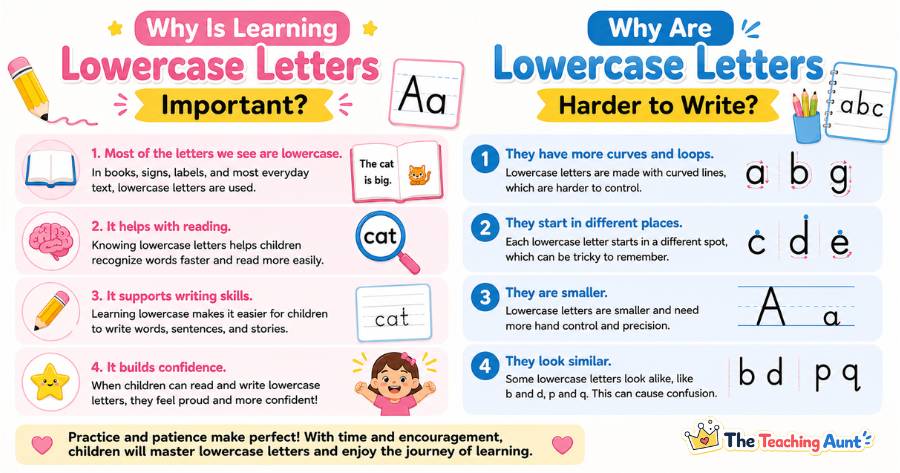
Why Is Learning Lowercase Letters Important?
Uppercase letters often get a lot of attention when children first learn the alphabet.
But when children begin reading books and sentences, they quickly discover something important:
Most of the letters they see are lowercase.
Look at a simple sentence:
The cat is big.
Only the first letter is capitalized. Almost everything else is written in lowercase.
That means recognizing lowercase letters is especially important for beginning readers.
Children need to learn that:
A and a are the same letter.
B and b are the same letter.
D and d are the same letter.
And so on.
Tracing lowercase letters gives children an opportunity to practice recognizing these forms while also developing handwriting skills.
Why Are Lowercase Letters Harder to Write?
Lowercase letters can be challenging because they come in many different shapes and sizes.
Some letters stay in the middle writing space.
Think of:
a, c, e, i, m, n, o, r, s, u, v, w, x, and z
Other letters are tall and reach upward:
b, d, f, h, k, l, and t
And some letters have parts that drop below the writing line:
g, j, p, q, and y
Children have to learn not only the shape of each letter but also where that letter sits on the writing line.
This takes practice.
Tracing provides extra guidance while children develop those movements.
What Skills Do Lowercase Tracing Worksheets Develop?
Letter tracing is more than simply following dotted lines.
As children trace lowercase letters, they can practice:
- Lowercase letter recognition
- Correct letter formation
- Pencil control
- Fine motor skills
- Hand-eye coordination
- Visual-motor skills
- Writing on lines
- Handwriting confidence
With repeated practice, children gradually begin remembering the movements without needing tracing guides.
The goal isn’t to trace forever.
Tracing is simply one step on the way to independent writing.
How to Teach Lowercase Letter Formation
Before giving your child a worksheet, demonstrate the letter first.
Show them exactly where to start.
Then slowly form the letter while describing the movement using simple words.
For example, when teaching lowercase l, you might say:
“Start at the top. Go straight down.”
For lowercase c:
“Start here. Curve around.”
Keep your instructions short.
Young children don’t need complicated handwriting terminology. Clear directions that are repeated consistently are often much easier to remember.
After demonstrating the letter, ask your child to trace it with their finger.
Then they can trace it using a crayon, marker, or pencil.
Finger Trace First
One of my favorite ways to introduce a letter is to let children trace it without a pencil.
Use your finger!
Point to the starting position and slowly follow the shape of the letter.
Children can even say the movement while they trace.
For example:
“Down… around…”
or:
“Up… down… across…”
Finger tracing helps children focus on how the letter moves without also having to concentrate on pencil grip.
Once they understand the movement, bring out the writing tools.
Watch Out for b, d, p, and q!
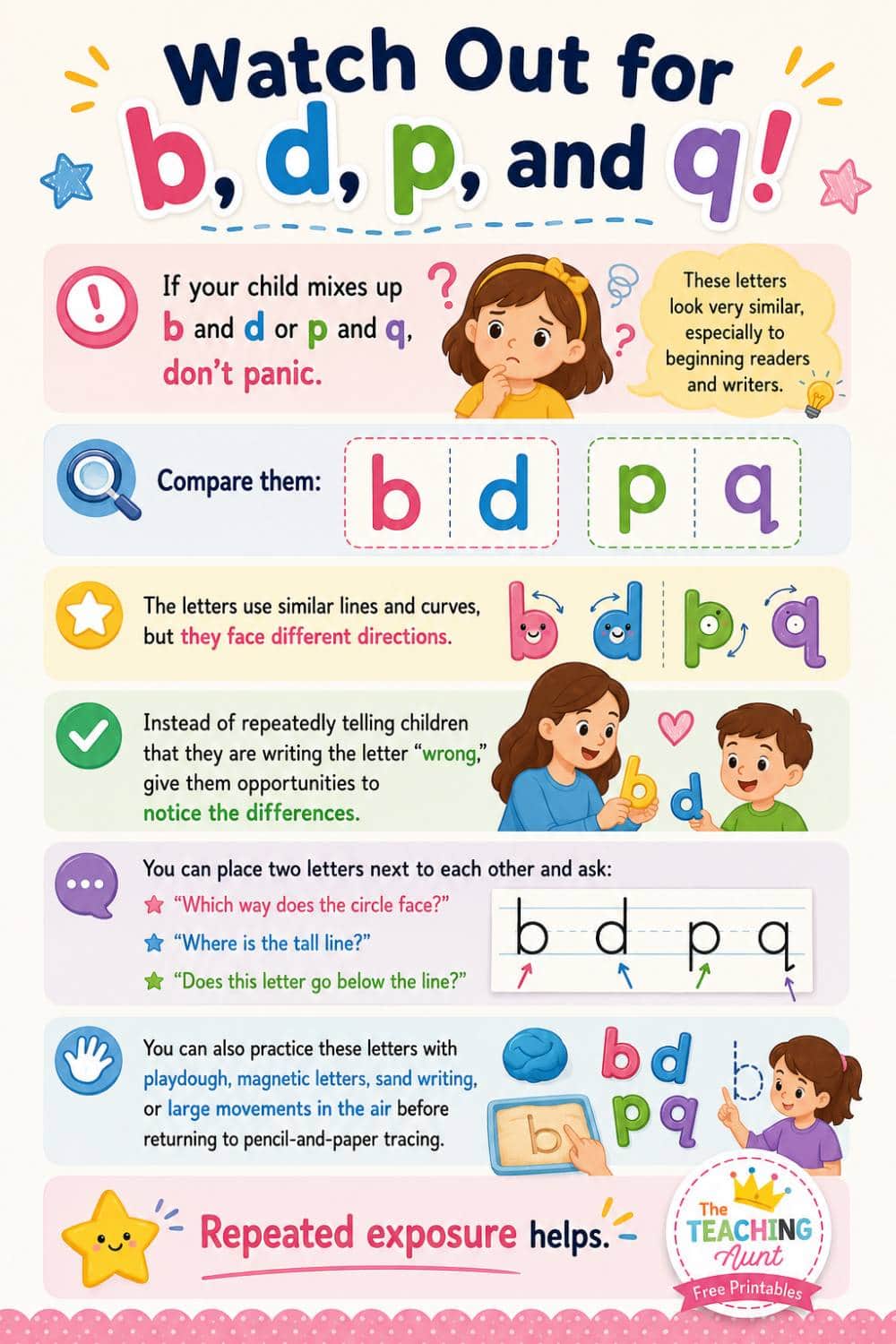
If your child mixes up b and d or p and q, don’t panic.
These letters look very similar, especially to beginning readers and writers.
Compare them:
b d
p q
The letters use similar lines and curves, but they face different directions.
Instead of repeatedly telling children that they are writing the letter “wrong,” give them opportunities to notice the differences.
You can place two letters next to each other and ask:
“Which way does the circle face?”
“Where is the tall line?”
“Does this letter go below the line?”
You can also practice these letters with playdough, magnetic letters, sand writing, or large movements in the air before returning to pencil-and-paper tracing.
Repeated exposure helps.
Practice Lowercase Letters with Hands-On Activities
Worksheets are useful for handwriting practice, but children don’t have to learn letters only with pencils.
Try making lowercase letters using:
- Playdough
- Sand
- Flour
- Paint
- Sidewalk chalk
- Yarn
- Craft sticks
- Magnetic letters
- Building blocks
- Finger paint
You can also write a large lowercase letter and have children cover the lines with small objects such as buttons or pom-poms.
These activities help children become familiar with letter shapes while also developing fine motor skills.
Match Uppercase and Lowercase Letters
Lowercase handwriting practice is a great opportunity to reinforce uppercase and lowercase letter matching.
Write or display pairs such as:
A — a
B — b
C — c
D — d
Ask your child:
“Can you find the lowercase partner?”
You can turn this into a simple matching game using alphabet flashcards or magnetic letters.
This helps children understand that although uppercase and lowercase letters may look different, they represent the same letter and sound.
If your child still needs more practice writing capital letters, you can also use my Uppercase Letter Tracing Worksheets A–Z.
→ Get the Free Uppercase Letter Tracing Worksheets A–Z
Practice the Letters in Your Child’s Name
Names are wonderful teaching tools because they are meaningful to children.
Start by writing your child’s name correctly, with an uppercase first letter followed by lowercase letters.
For example:
Mia
Point to the capital M and then look at the lowercase i and a.
Ask:
“Can you find the lowercase letters in your name?”
Then use the matching lowercase tracing worksheets to practice those letters.
Children are often much more motivated to write when they realize:
“Those are MY letters!”
Try Rainbow Tracing
If regular pencil tracing starts to feel repetitive, add some color.
Try rainbow tracing.
Children trace the same lowercase letter several times using different crayons or colored pencils.
For example:
Trace m in red.
Trace it again in orange.
Then yellow.
Then green.
Then blue.
Children get repeated handwriting practice while creating a colorful letter at the same time.
Simple activities like this can make tracing much more enjoyable for preschoolers.
Make the Worksheets Reusable
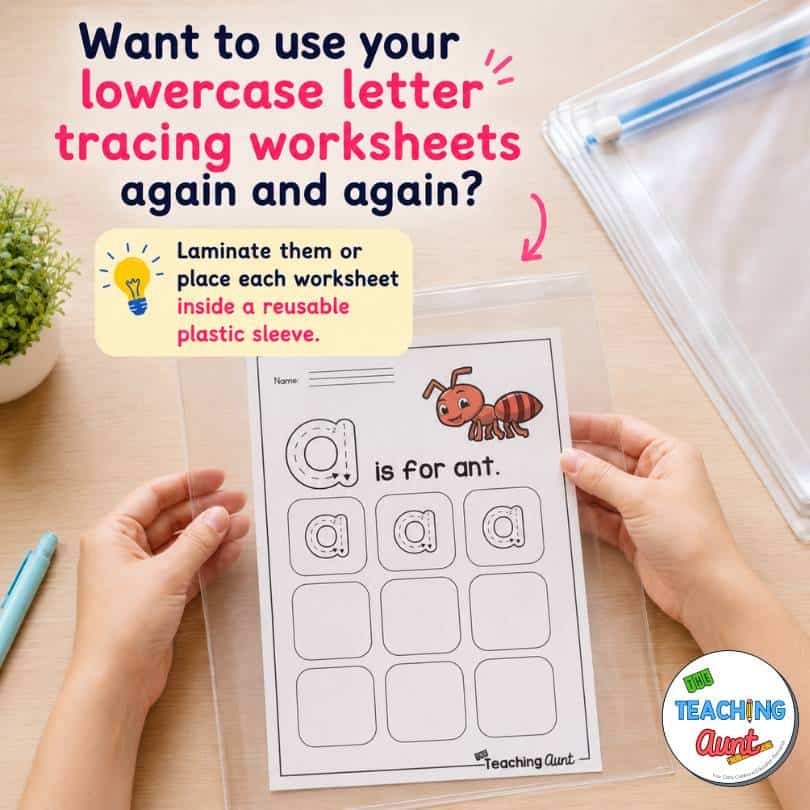
Want to use your lowercase letter tracing worksheets again and again?
Laminate them or place each worksheet inside a reusable plastic sleeve.
Children can then use a dry-erase marker to trace the letters.
When they’re finished:
Wipe and try again!
This works especially well for classroom literacy centers, homeschool practice, or children who need extra repetition with particular letters.
You can also keep the worksheets together in a binder to create a reusable lowercase handwriting practice book.
How Often Should Children Practice Lowercase Letters?
Young children usually benefit more from short, consistent handwriting practice than long worksheet sessions.
Around 5 to 10 minutes at a time may be enough for many preschoolers and beginning writers.
You might spend several days exploring one letter.
For example:
Day 1: Introduce lowercase m and its sound.
Day 2: Make m using playdough.
Day 3: Finger trace and complete the lowercase m tracing worksheet.
Day 4: Find lowercase m in a book.
Day 5: Try writing m independently.
This gives children several opportunities to see, say, form, and write the same letter.
Move from Tracing to Independent Writing
Remember that tracing is not the final goal.
Eventually, children need to form letters without dotted guides.
You can make the transition gradually.
Try this sequence:
1. Finger trace the letter.
2. Trace a large guided letter.
3. Trace dotted letters with a pencil.
4. Copy the letter beside a model.
5. Write the letter independently.
Some children will move through these stages quickly.
Others will need more time.
That’s okay.
The important thing is that children gradually become less dependent on the tracing guide.


Looking for Complete Alphabet Tracing Practice?
If your child is working on both uppercase and lowercase letters, visit my complete Alphabet Tracing Worksheets A–Z collection.
It brings together more handwriting resources for children learning to recognize, trace, and write the alphabet.
→ Explore the Free Alphabet Tracing Worksheets A–Z
Use the complete collection for general alphabet handwriting practice, or return to these lowercase worksheets when your child needs extra practice with small letter formation.
Your child may also practice tracing uppercase letters so they can master both forms.
→ Explore the Free Uppercase Letter Tracing Worksheets
Fun Ways to Practice Lowercase Letters
You can reinforce lowercase letter recognition throughout the day without adding another worksheet.
Try a lowercase letter hunt.
Choose one letter—for example, lowercase a.
Then look for it in:
- Picture books
- Food packaging
- Classroom labels
- Signs
- Magazines
- Worksheets
- Posters
Every time your child finds the target letter, point to it and say its name and sound together.
You can also challenge older preschoolers to find the uppercase partner.
Alphabet learning suddenly becomes a treasure hunt!
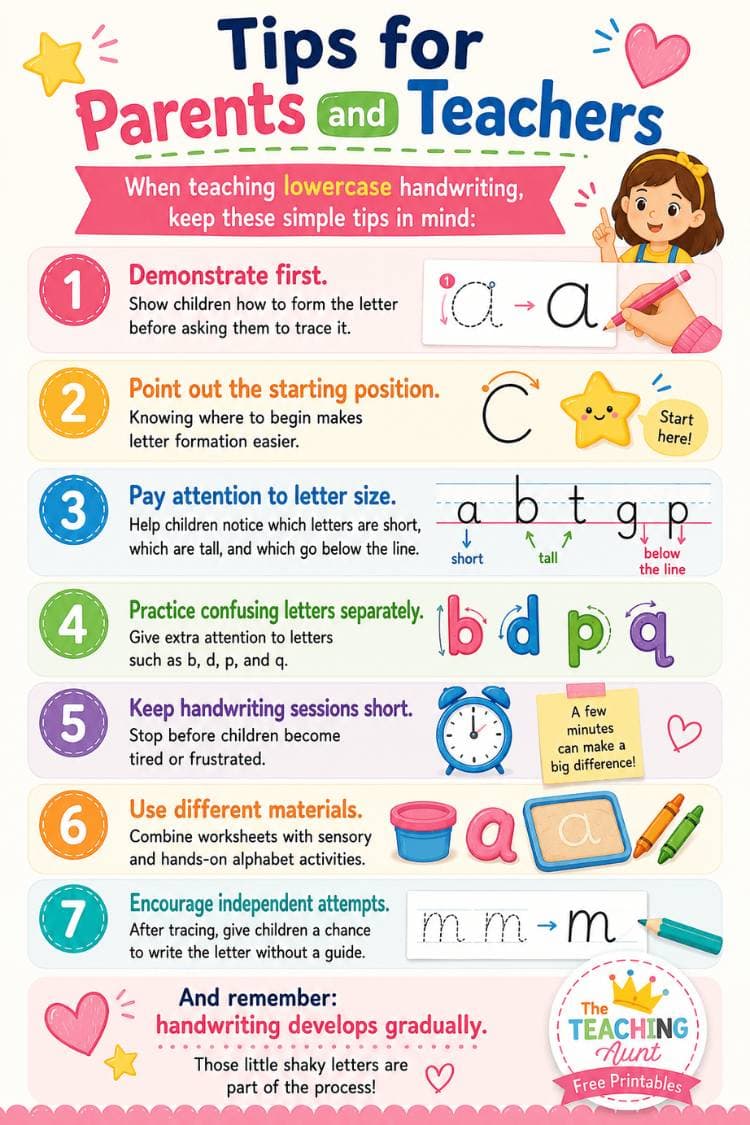
Tips for Parents and Teachers
When teaching lowercase handwriting, keep these simple tips in mind:
Demonstrate first.
Show children how to form the letter before asking them to trace it.
Point out the starting position.
Knowing where to begin makes letter formation easier.
Pay attention to letter size.
Help children notice which letters are short, which are tall, and which go below the line.
Practice confusing letters separately.
Give extra attention to letters such as b, d, p, and q.
Keep handwriting sessions short.
Stop before children become tired or frustrated.
Use different materials.
Combine worksheets with sensory and hands-on alphabet activities.
Encourage independent attempts.
After tracing, give children a chance to write the letter without a guide.
And remember: handwriting develops gradually.
Those little shaky letters are part of the process!
Frequently Asked Questions
What are lowercase letter tracing worksheets?
Lowercase letter tracing worksheets are handwriting practice pages that help children learn to form small letters from a to z. Children follow guided or dotted letters before progressing to independent writing.
What age should children start tracing lowercase letters?
Many children begin lowercase letter practice during preschool and kindergarten. Readiness varies, so children should also have opportunities to develop pencil control through coloring, drawing, line tracing, and fine motor activities.
Should children learn uppercase or lowercase letters first?
Many children find uppercase letters easier to write because their shapes often use simpler lines and curves. However, children should learn to recognize both forms. Lowercase letters are especially important because they appear much more frequently in books and everyday writing.
Why does my child confuse b and d?
Lowercase b and d have very similar shapes that face opposite directions, which can make them difficult for beginning readers and writers to distinguish. Repeated practice, letter comparison, and hands-on activities can help children become more familiar with their differences.
How can I make lowercase tracing worksheets reusable?
Place the worksheets inside reusable plastic sleeves or laminate them. Children can use dry-erase markers to trace the letters, wipe the pages clean, and practice again.
Download the Free Lowercase Letter Tracing Worksheets a–z
Ready to practice small letters?
Download and print these free lowercase letter tracing worksheets a–z for your preschooler, kindergarten student, homeschool lessons, or classroom handwriting activities.


Work through the letters slowly and give children plenty of opportunities to trace, play, and write.
Remember:
See the letter.
Say the letter.
Trace the letter.
Write the letter.
With practice, those dotted tracing letters will eventually turn into confident independent writing!
For more handwriting resources, visit my complete Alphabet Tracing Worksheets A–Z collection.
Or just visit my Free Printable Page for more!

P.S.
Do you want PREMIUM FREEBIES? Please subscribe to my blog. I promise it will be worth it!
Oh! And please like and follow us on Facebook and Pinterest! <3
Happy learning,

Last Updated: 23rd July 2026




15 Responses
Thank you so much! It’s helpful.
Happy to serve! I’m glad you liked the worksheets. 🙂
Thank you for sharing from your wealth of experience for free May God almighty bless you and give this your seed another body for the many lives you are impacting. Tons of love Vera Bassey from Nigeria
Happy to serve! Thank you so much for that lovely message. I really appreciate it. Happy learning!
Thank you for this website. I’m teaching my 5 year old granddaughter through virtual learning. She has autism and she enjoys these worksheets.
Thank you so much for reaching out. I’m glad to be of service. Best of luck to you and your granddaughter. Happy learning!
Hi Teacher Nessy! I just wanted to say thank you for this amazing site you have here. I searched for a long time to find worksheets my toddlers would enjoy and I have finally found them on your site! Keep up the awesome work and thank you for these incredible printables!
thank you so much. Great work.
Thank you so much for the amazing worksheets! Really helpful
Dear Teacher Ness, I am a teacher and also a mom.. I really like your web, it really helps me so much…
During my teaching days at school 20 years back, the sources were almost all are hand made, no sources like this…
Thank you so much teacher Ness, God Bless you…
Thank you for these worksheets – so lovely and so super helpful! 🙂
Love the worksheets! My daughter enjoys them, Thank you!
Live the worksheets! My daughter enjoys them, Thank you!
These help my little girl so much!!
Thank you thank you thank you!!!
I am so happy that your daughter finds the printable helpful! 😁 I hope you enjoy my other printables. Happy learning!