
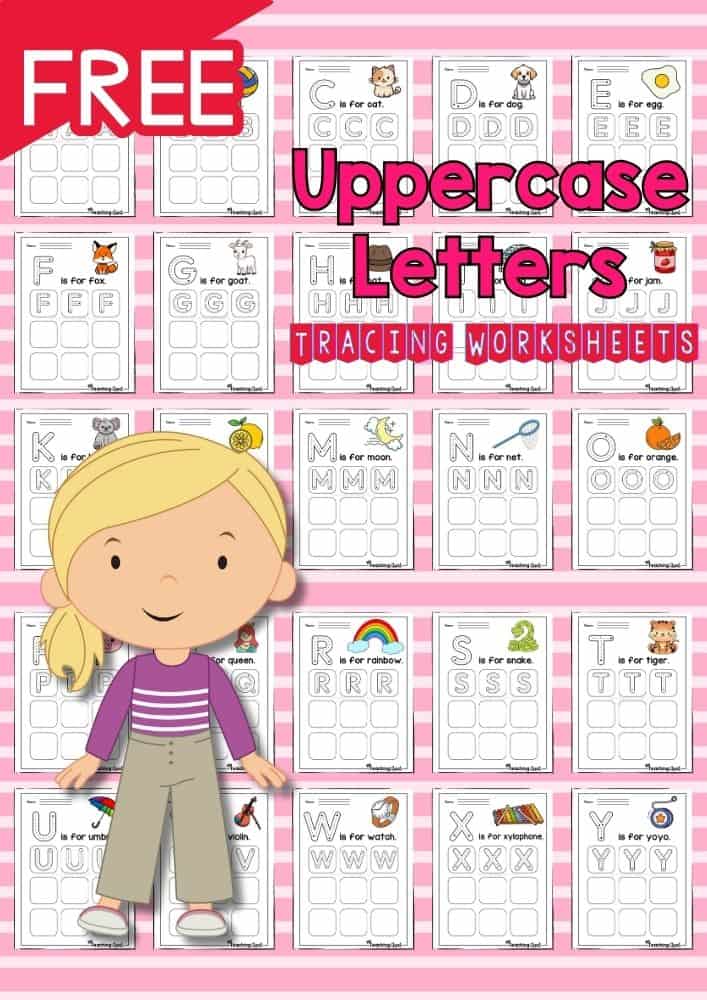
If your child or students are beginning handwriting practice, these free uppercase letter tracing worksheets provide guided practice for writing capital letters from A to Z.
These printable worksheets are designed especially for preschool and kindergarten children who are developing pencil control and learning correct letter formation.
As a preschool teacher, I’ve seen how much easier handwriting becomes when children are given plenty of opportunities to trace before they are expected to write letters independently.
Start slowly, practice a little at a time, and celebrate those wiggly first letters!
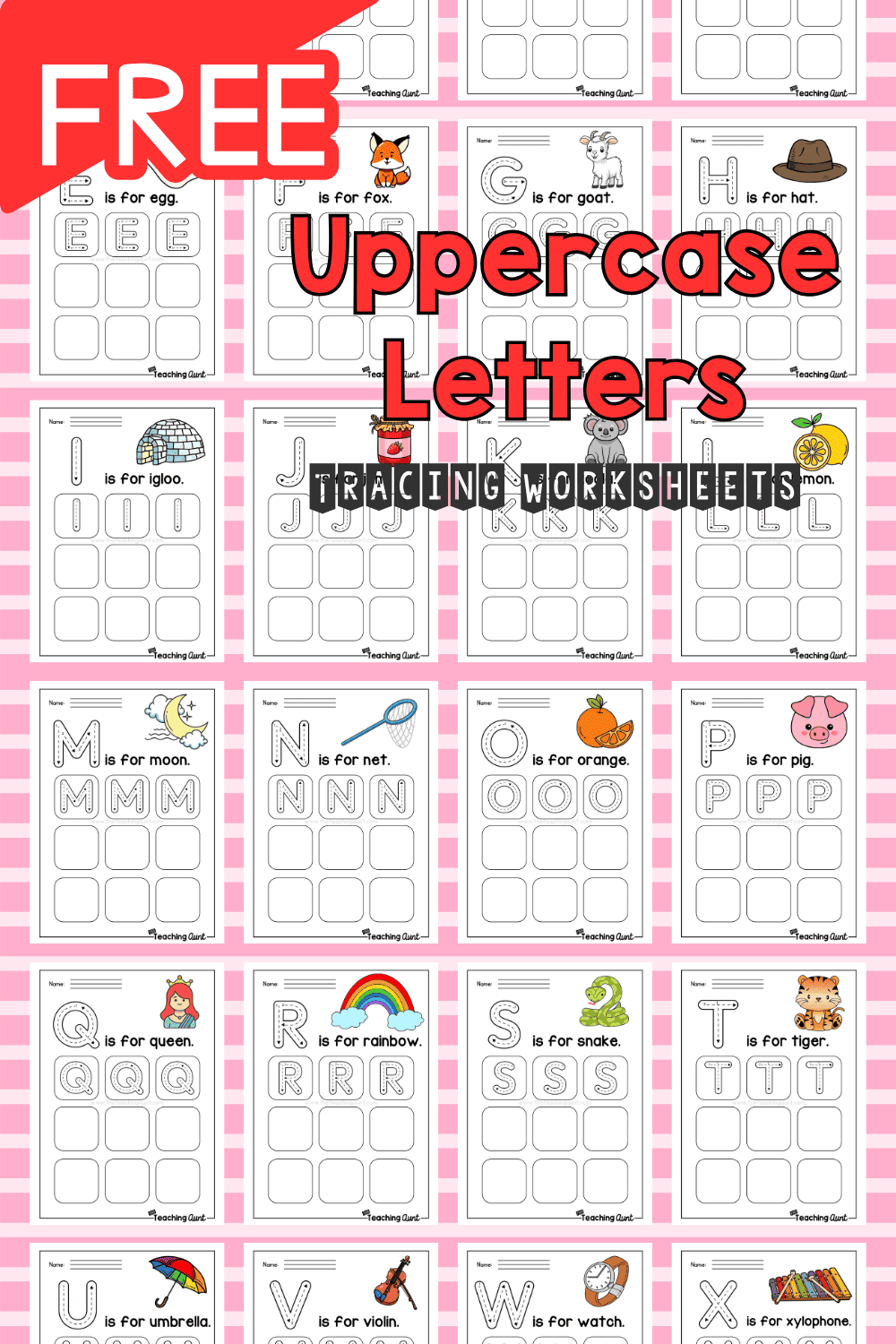
Free Uppercase Letter Tracing Worksheets A–Z
This printable set includes uppercase letter tracing worksheets for all 26 capital letters of the English alphabet.
Children can practice tracing:
A B C D E F G H I J K L M
N O P Q R S T U V W X Y Z
Each worksheet gives young learners guided handwriting practice so they can become familiar with the lines and curves used to form each capital letter.
These worksheets are great for:
- Preschool handwriting practice
- Kindergarten alphabet lessons
- Homeschool activities
- Literacy centers
- Morning work
- Independent practice
- Homework and review
- Fine motor practice
You don’t have to complete the entire alphabet at once. One or two letters at a time is plenty for beginning writers.
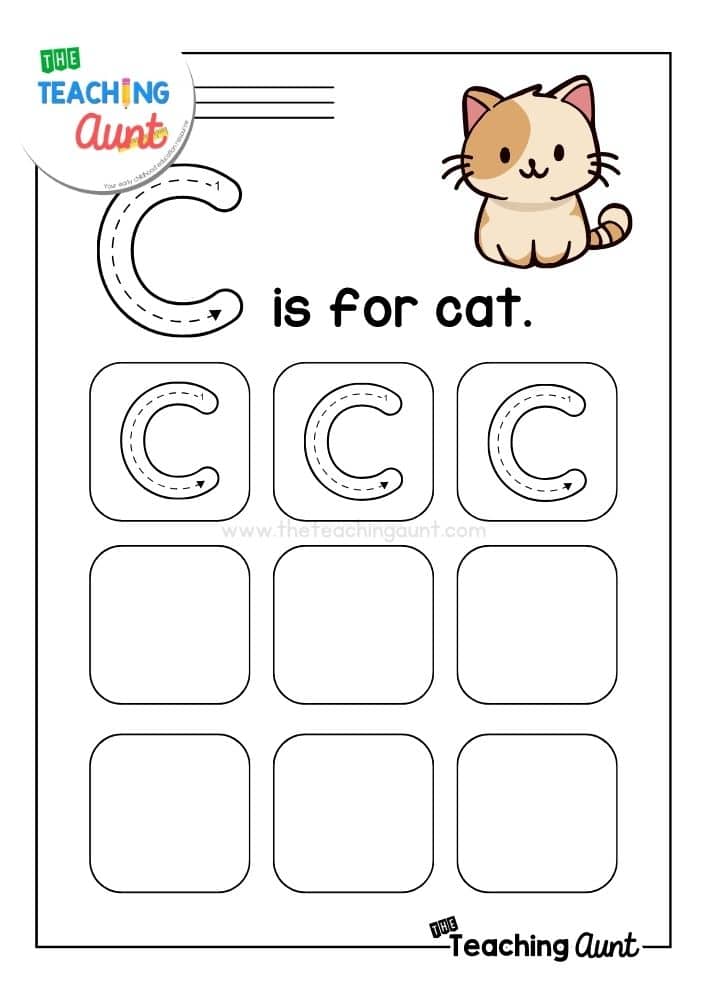
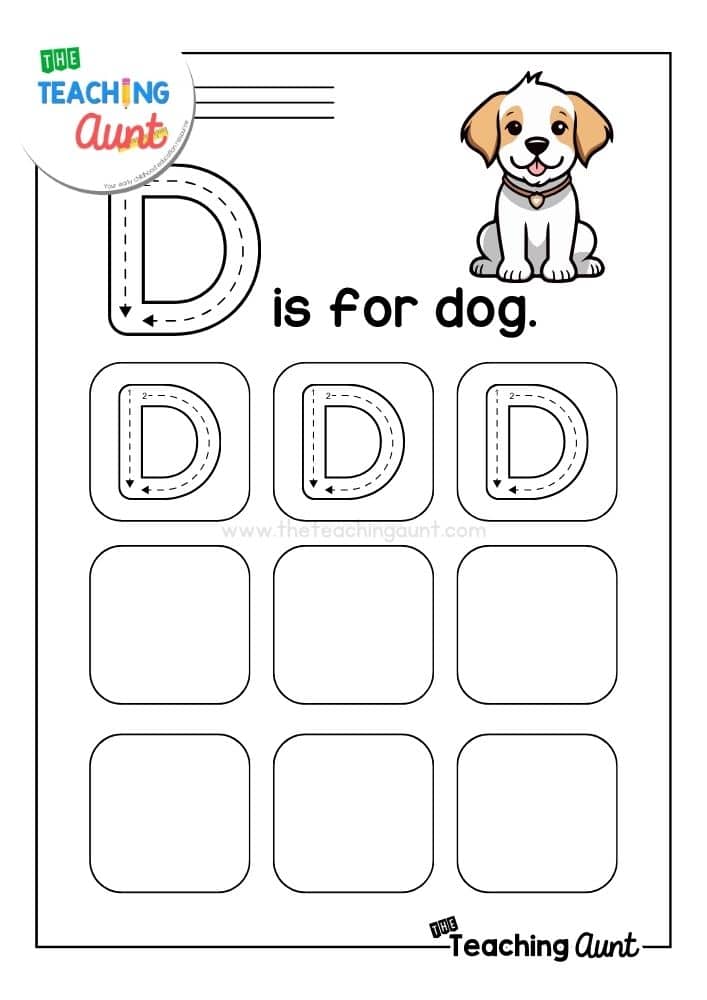
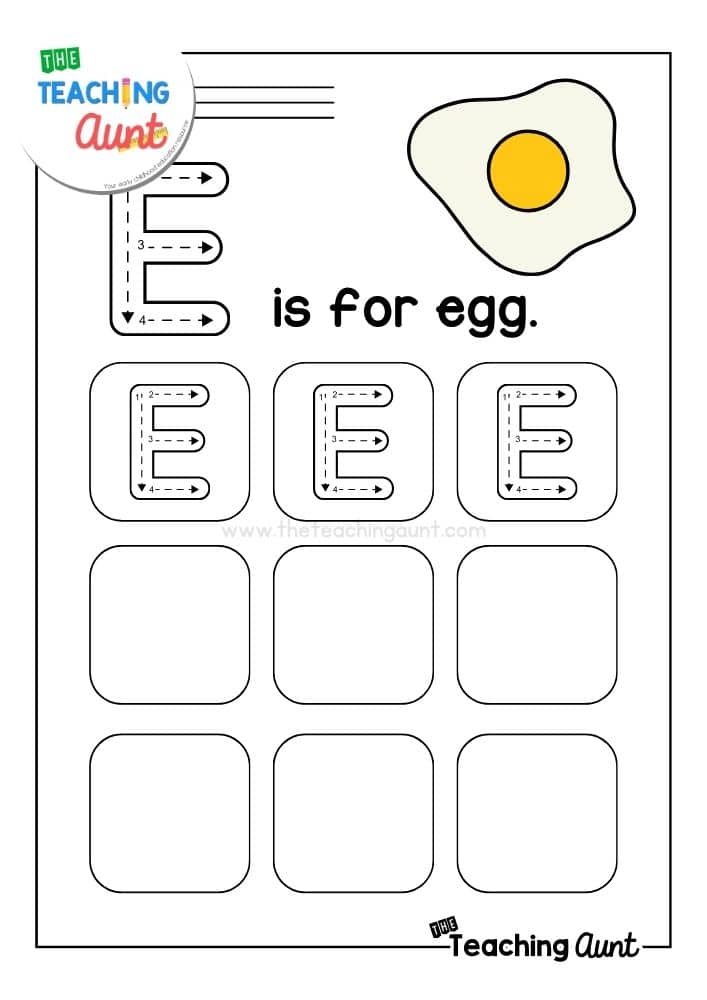
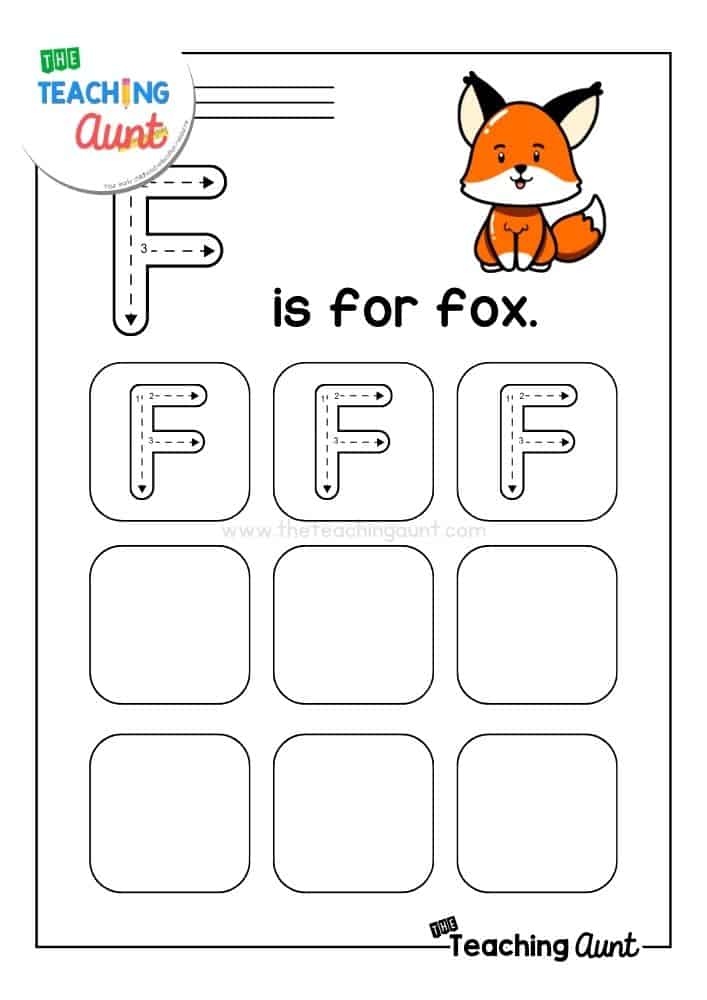
Why Start with Uppercase Letters?
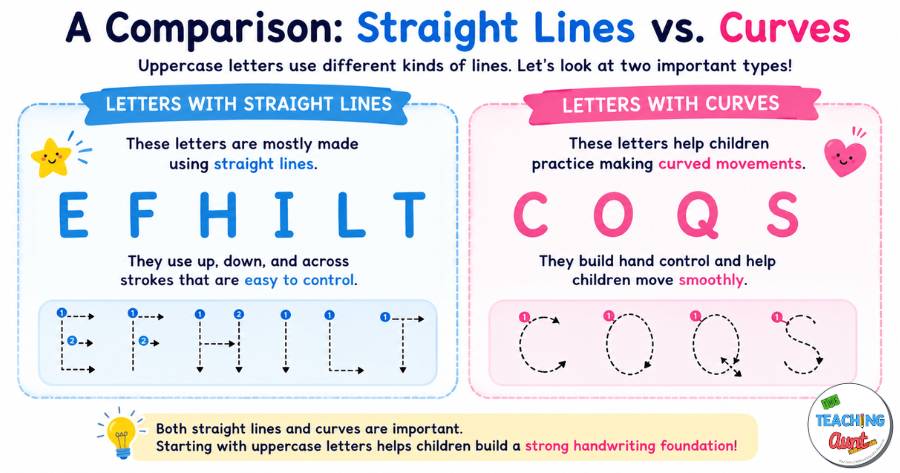
Many young children find uppercase letters easier to write because capital letters often use simple straight lines and basic curves.
Think about letters such as:
E, F, H, I, L, and T
These letters are mostly made using straight lines.
Other capital letters, such as:
C, O, Q, and S
give children practice making curved movements.
Because of these relatively simple shapes, uppercase letters can be a good starting point for children who are just beginning formal handwriting practice.
Capital letters are also highly meaningful to young children.
One of the first letters many children recognize is the first letter of their name.
There is something very exciting about a preschooler pointing to a giant letter and proudly announcing:
“That’s MY letter!”
Use that excitement to encourage more alphabet learning.
What Do Children Learn from Letter Tracing?
Tracing may look like a simple activity, but young children are practicing several skills at the same time.
Uppercase letter tracing can help develop:
- Capital letter recognition
- Letter formation
- Pencil control
- Fine motor skills
- Hand-eye coordination
- Left-to-right movement
- Visual-motor coordination
- Handwriting confidence
Most importantly, children begin learning the movements needed to form each letter.
With repeated practice, they gradually rely less on tracing guides and become more confident writing capital letters independently.
How to Teach Uppercase Letter Formation
Before asking children to trace a new letter, demonstrate how to write it.
Show them:
Where does the letter start?
Which direction does the pencil move?
Which line comes next?
Simple verbal directions can help children remember the movements.
For example, when teaching uppercase L, you might say:
“Start at the top. Go straight down. Then go across.”
For uppercase O:
“Start at the top and go all the way around.”
Keep your directions short and consistent.
Young children don’t need a complicated explanation. They need a clear demonstration and lots of opportunities to practice.
Practice Uppercase Letters With Me!
Ready to practice uppercase letters together? In this video, we’ll trace uppercase letters step by step and follow the arrows to practice the correct letter strokes.
You can pause the video whenever your child needs more time to practice. After watching, use the free uppercase letter tracing worksheets below to continue practicing.
Finger Trace Before Using a Pencil
Here’s a simple trick I like to use before giving children a pencil:
Trace the letter with a finger first.
Ask the child to place their finger at the starting point and slowly follow the letter.
You can trace it together while saying the directions aloud.
After finger tracing, move on to a crayon, marker, or pencil.
This gives children a chance to learn the movement before adding the extra challenge of controlling a writing tool.
Start with the Letters in Your Child’s Name
You don’t always have to teach capital letters from A to Z.
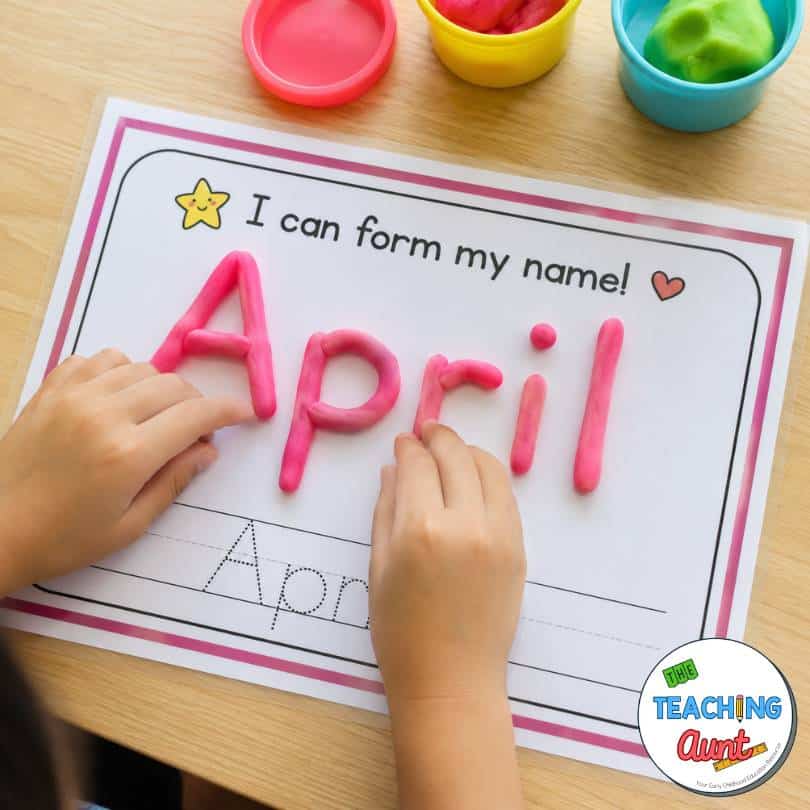
For many preschoolers, their name is the perfect place to begin.
Write your child’s name using capital letters and point out the first letter.
For example:
M is for Mia!
Then find the uppercase M tracing worksheet and practice it together.
Children are often much more interested in writing letters when those letters have a personal meaning.
After practicing the letters in their name, you can gradually introduce other capital letters.
Practice Uppercase Letters with Different Materials
Handwriting practice doesn’t always need to happen with pencil and paper.
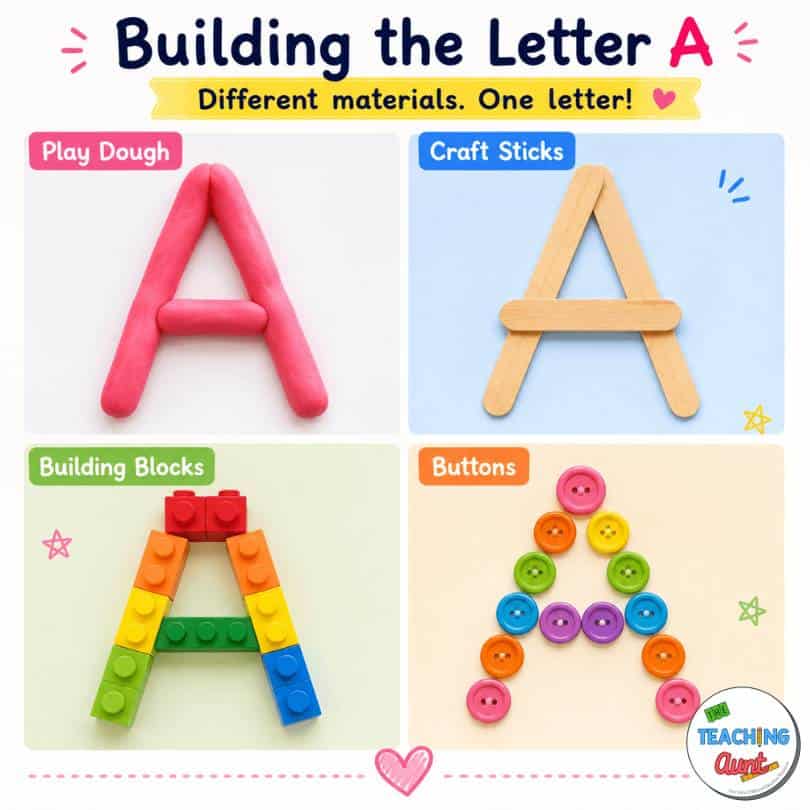
Before or after completing an uppercase tracing worksheet, let children form the same letter using different materials.
Try:
- Playdough
- Craft sticks
- Building blocks
- Yarn
- Buttons
- Sidewalk chalk
- Paint
- Sand
- Shaving foam
- Magnetic letters
You can also ask children to make giant letters in the air using their fingers.
These hands-on activities help reinforce letter shapes while keeping alphabet practice playful.
Try Rainbow Letter Tracing
Want to make these uppercase letter tracing worksheets more colorful?
Try rainbow tracing!
Have children trace the same capital letter using several different crayons or colored pencils.
They might trace:
A in red.
Then A in orange.
Then yellow, green, blue, and purple.
Repeating the same letter gives children additional formation practice, while the different colors make the activity feel more like art than handwriting work.
Use Dry-Erase Markers for Repeated Practice
If you’re using these worksheets in a preschool or kindergarten classroom, consider laminating them or placing them inside reusable plastic sleeves.
Children can trace the uppercase letters using dry-erase markers.
Then:
Trace. Wipe. Repeat!
This is especially useful for literacy centers because the same worksheets can be used again and again.
It also allows children to practice difficult letters several times without needing another printed copy.
Don’t Rush Letter Writing
Young children are still developing the muscles needed for handwriting.
That means their first capital letters probably won’t look perfect.
You may see:
- Shaky lines
- Uneven letters
- Letters that are too big
- Letters outside the writing lines
- Incorrect starting points
- Backward letters
These are common during the early stages of writing.
Instead of focusing on perfect handwriting, help children learn the correct movements and encourage them to keep practicing.
A simple:
“Great try! Let’s do another one.”
can go a long way.
How Often Should Children Practice Uppercase Letters?
Short handwriting sessions are usually best for preschoolers.
Around 5 to 10 minutes of focused practice can be enough for a young child.
You might spend several days working on one letter instead of introducing a new one every day.
For example:
Day 1: Introduce uppercase A and talk about its shape.
Day 2: Make uppercase A with playdough or craft sticks.
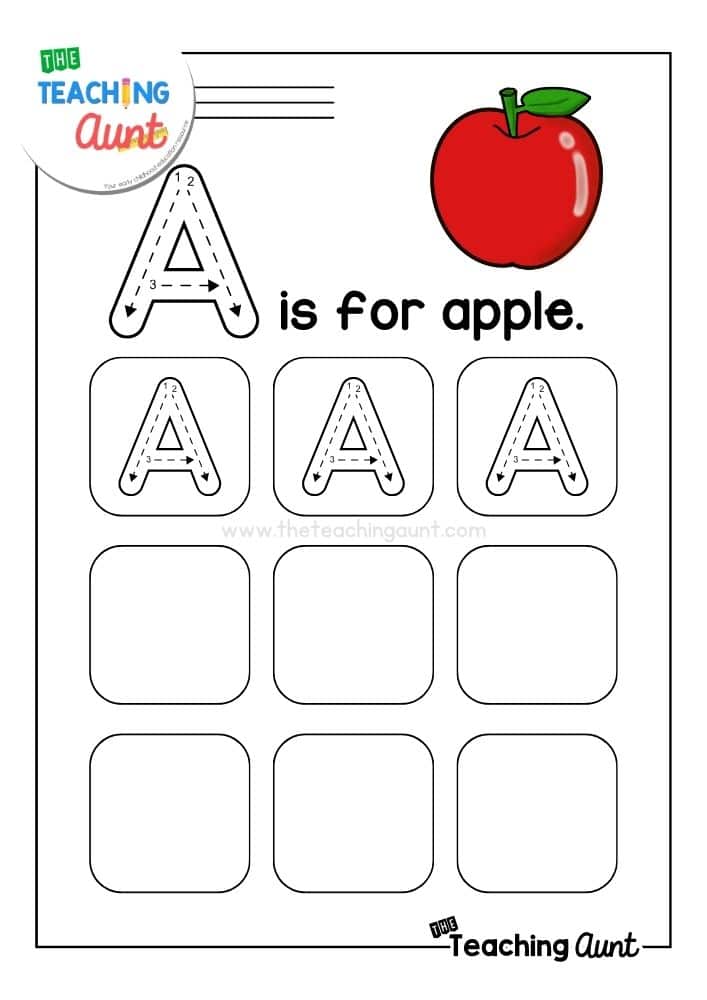
Day 3: Finger trace and complete the uppercase A tracing worksheet.
Day 4: Look for uppercase A in books, signs, and around the classroom.
Day 5: Try writing uppercase A without tracing.
This gives children repeated exposure without turning handwriting into a long or tiring activity.
Uppercase and Lowercase Letters
While these worksheets focus specifically on uppercase letter tracing, children will eventually need to recognize and write both forms of every letter.
For example:
A → a
B → b
C → c
D → d
Once your child becomes comfortable with capital letters, you can introduce more focused lowercase handwriting practice.
→ Get the Free Lowercase Letter Tracing Worksheets a–z
You can also practice matching uppercase letters with their lowercase partners.
This helps children understand that uppercase A and lowercase a are two forms of the same letter.


Looking for More Alphabet Tracing Practice?
If you want uppercase and lowercase handwriting activities together, visit my complete Alphabet Tracing Worksheets A–Z collection.
There you’ll find more printable resources for children who are learning to recognize, trace, and write letters.
→ Explore the Free Alphabet Tracing Worksheets A–Z
This is a great place to start if you’re planning a complete alphabet handwriting unit for preschool or kindergarten.
More Ways to Practice Capital Letters
Worksheets are useful, but children learn best when alphabet practice happens in different ways.
Try combining these uppercase tracing worksheets with activities such as:
- Capital letter hunts
- Alphabet puzzles
- Letter matching games
- Alphabet flashcards
- Letter crafts
- Beginning sound activities
- Name writing
- Alphabet songs
- Sensory letter formation
For a simple letter hunt, choose one capital letter and ask children to find it around the room.
You can look in:
Books.
Posters.
Labels.
Signs.
Toy packaging.
Anywhere you see print!
Children quickly discover that letters are all around them.
Tips for Parents and Teachers
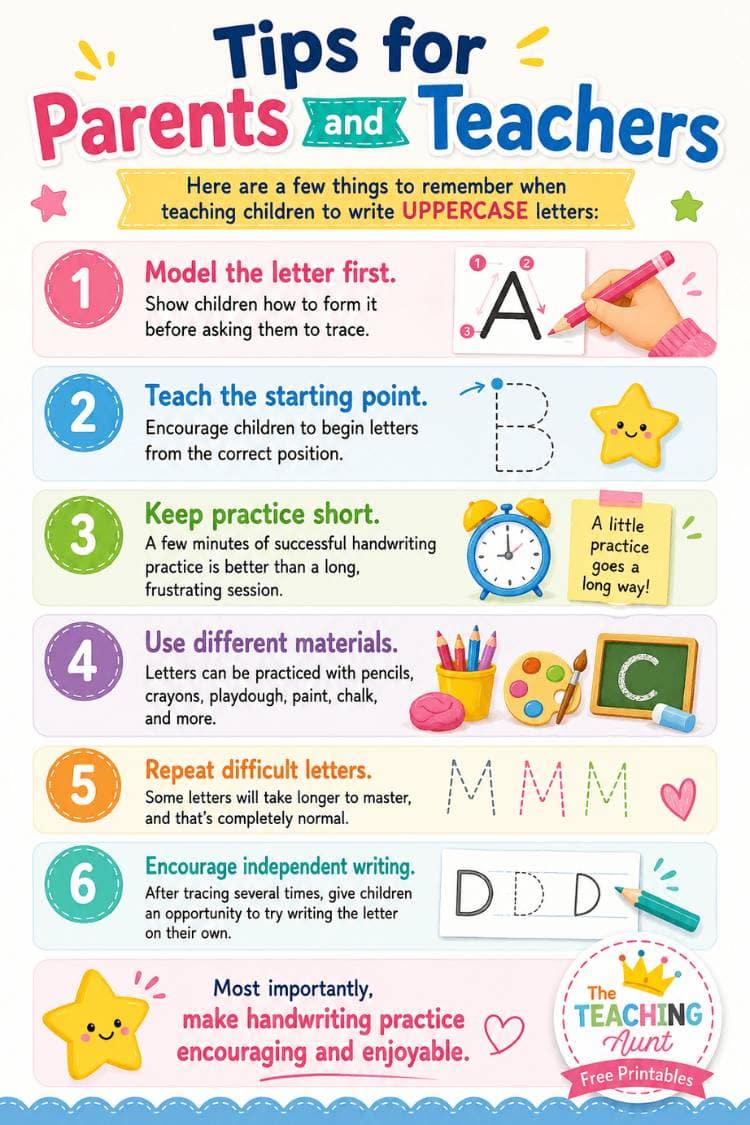
Here are a few things to remember when teaching children to write uppercase letters:
Model the letter first.
Show children how to form it before asking them to trace.
Teach the starting point.
Encourage children to begin letters from the correct position.
Keep practice short.
A few minutes of successful handwriting practice is better than a long, frustrating session.
Use different materials.
Letters can be practiced with pencils, crayons, playdough, paint, chalk, and more.
Repeat difficult letters.
Some letters will take longer to master, and that’s completely normal.
Encourage independent writing.
After tracing several times, give children an opportunity to try writing the letter on their own.
Most importantly, make handwriting practice encouraging and enjoyable.
Frequently Asked Questions
What are uppercase letter tracing worksheets?
Uppercase letter tracing worksheets are handwriting practice pages that help children learn how to form capital letters. Children follow guided or dotted letters before progressing to independent writing.
What age should children start tracing uppercase letters?
Many children begin letter tracing during the preschool years, although handwriting readiness varies from child to child. Before tracing letters, children benefit from activities that develop pencil control and fine motor skills.
Should children learn uppercase letters first?
Some children find uppercase letters easier to form because many capital letters use simple straight lines and curves. However, children should eventually learn to recognize and write both uppercase and lowercase letters.
Should children learn capital letters in alphabetical order?
Not necessarily. You can teach A–Z in order, but you can also begin with meaningful letters, such as the first letter of a child’s name. The important thing is providing repeated practice and gradually introducing all 26 letters.
How can I reuse these uppercase tracing worksheets?
Laminate the worksheets or place them inside reusable plastic sleeves. Children can trace the capital letters using dry-erase markers, wipe them clean, and practice again.
Download the Free Uppercase Letter Tracing Worksheets A–Z
Ready to practice capital letters?
Download and print these free uppercase letter tracing worksheets A–Z for your preschooler, kindergarten student, homeschool lessons, or classroom handwriting activities.

Want to practice letter formation with me first? Watch the Uppercase Letters Tracing video above, then print the worksheets and practice each letter at your own pace.
Remember, children don’t need to master every capital letter immediately.
Practice one letter at a time.
Trace it.
Say it.
Make it.
Write it.
And most importantly, have fun learning!
For even more handwriting practice, visit my complete Alphabet Tracing Worksheets A–Z collection for uppercase and lowercase alphabet resources.
Or just visit my Free Printable Page for more!

P.S.
Do you want PREMIUM FREEBIES? Please subscribe to my blog. I promise it will be worth it!
Oh! And please like and follow us on Facebook and Pinterest! <3
Happy learning,

Last Updated: 23rd July 2026



35 Responses
I’m so happy I found your website! Thank you so much for providing all this material. I’m super excited to start teaching my toddlers!
Thank you so much! Best of luck to your toddlers! 🙂
Thank you for this! It helps a lot 🙂
Thank you so much. This is very helpful for me. My students will surely love this. 🙂
I love your pages a lot dear Nessy! its very useful and designed . thank you for sharing those things !
Hello, Bella! Thank you very much for your message. This truly made my day. 🙂 I’m glad you find the website helpful. Happy learning!
Thanks for these… This will help my son a lot
I’m so happy that you find the printable helpful. I appreciate your message. Happy learning! 🙂
These remind me of elementary school. I remember using worksheets like these to learn to write my letters in print and cursive.
I’m glad my printable made you remember your childhood days. 😊 It’s good to think about those days from time to time.
This would be perfect for my son, I am so grateful to you for posting this! Educational options are so important!
You are welcome. 😊 I hope your son enjoys working on the worksheets. Happy learning!
Thank you for these! Perfect for my 4 year old to practice 🙂
Glad you liked it! Thanks! Happy learning! 🤓
Hi Nessy. I totally agree with you. I not only allow my kids making theirs choices and decisions. I promote and facilitate that. Now they are 17 and 15 and even if it wasn’t easy all the time, I see them maturing and becoming young responsible and independent individual. Your blog is adorable. Keep the good work Aunt!
Congratulations for rearing such responsible and independent individuals! 😊 I hope my nephew grows up to be one as well. Oh! And thank you.
Those free printable worksheets look great. Kids usually love it if there are cute designs in the paper.
My youngest is in pre-K, and these will be perfect for at home practice! I like to let him (and his other brother) choose what they do, but I like to have educational options available.
That is so true! It’s always good to have educational options available. We want them to be good decision makers so giving them a good option would help them lead towards that direction. 😊
I remember doing these worksheets with i was so little. Sending this to my niece for her little ones to do.
Oh! Thank you so much! I appreciate you sharing this post. Happy learning!
These are just fabulous worksheets to teach kids how to write letters. I used them when I was a teacher in the first grades of primary school. 🙂
Thank you. I really try to come up with cute worksheets so my students will feel more excited to work on them. 😊 Oh, and it’s nice to hear from a fellow teacher. Happy learning!
This looks great. My sister in law teaches so I’ll have to send her these. Ah it brings so many memories as a young child.
Oh man I remember doing this when I was in school. So hard to believe that my nephew will be learning soon. Thanks for sharing this with us!
super thank you for this ❤❣ very helpful to my son 🙂
You’re welcome. Happy learning! ❤️
I remember doing these types of sheets when I was in grade school. Seems like forever ago now!
Lol! Ikr! A few years ago we were the ones answering the worksheets, and now either we’re the ones making it or we have little kiddos who answer the worksheets. 😂
Soon my granddaughter will be learning her letters. This is something that her mom needs to know about.
Ooohh… I hope your granddaughter gets to practice with these worksheets. 😊
Super cute resources!
Love how they include a related coloring section for the kids, too! Kinesthetic and visual learning at the same time!
Thank you! 😊 I do try to include all types of learners when I make my worksheets. I’m glad my effort is noticeable.
These are great for small kids. Mine always liked practicing writing when they were tiny.
Thank you! My students find these worksheets cute, too. They love coloring the pictures aside from tracing. 😊